August 2, 2026
Large-Scale Potential Identified
A new assessment indicates the United States’ tidal energy resources are materially larger than many prior assumptions, with technical potential estimated to cover up to 57% of national electricity demand. The figure underscores how predictable marine currents could, in principle, contribute meaningful baseload-like generation to a grid increasingly shaped by weather-driven resources.
While the estimate speaks to resource scale rather than immediate deliverability, it places tidal energy firmly on the map for long-horizon planners evaluating diversified low-carbon supply. Resource concentration in high-current corridors and constrained waterways also implies development would likely be site-specific, requiring tailored engineering and permitting aligned with local conditions.
Real-World Testing Off Massachusetts
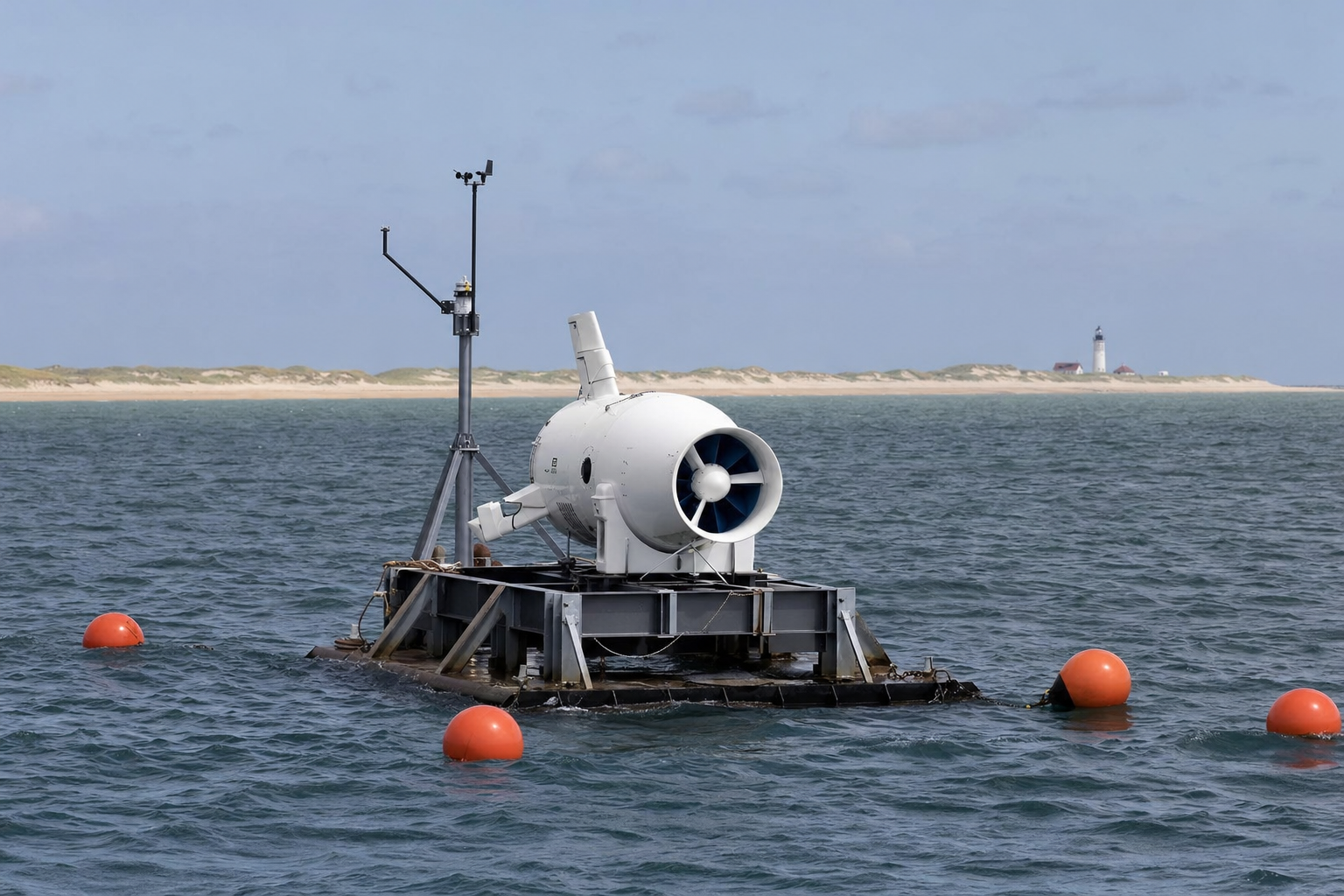
Alongside the resource estimate, technology validation is advancing in U.S. waters. An Alaska-based tidal energy company is piloting a small, modular turbine in strong tidal currents off Cape Cod, Massachusetts, to test performance and durability in real-world conditions. The goal is to understand how the device operates across tidal cycles, how components withstand marine stresses, and how maintenance needs evolve over time. Insights from the pilot will inform whether the design is suitable for commercial scaling.
Modularity is a central design choice under evaluation. Smaller, repeatable units can allow incremental deployment and staged learning curves, with the potential to match project size to site characteristics. The Cape Cod pilot aims to reduce uncertainty around survivability and efficiency, the two variables that most directly shape economics and operations in high-energy tidal channels.
Path to Commercial Deployment
Translating technical potential into delivered power will depend on device reliability, installation methods, and lifecycle costs, as well as site access and environmental considerations. Performance data from pilots are therefore pivotal: they help calibrate expectations for capacity factors, inform maintenance strategies, and frame the balance between upfront engineering and ongoing operating requirements.
If pilots validate durability and consistent output, tidal projects could complement variable renewables by adding highly predictable generation profiles tied to lunar cycles. That role is contingent on successful technology maturation and fit-for-purpose project designs at identified resource sites.
For readers tracking energy-transition technologies, it is notable that developments in marine power proceed independently of financial characteristics of allocated physical precious metals, which remain outside the power-generation value chain.